
The Three Ships 10 Year Old Single Malt that won World’s Best Blended Malt at the 2012 World Whiskies Awards was not a blended malt at all. This category quirk shows how South African whisky was seen then: an anomaly judges couldn’t classify, filed under a label that didn’t fit. A decade later, the question is whether the industry has forced the world to see it on its own terms, or whether it still borrows a vocabulary built for Scottish distilleries.
What the Wellington climate does to wood and time
The James Sedgwick Distillery sits in Wellington, Western Cape, where summer days push past 30°C and the temperature can drop 10 to 15 degrees overnight. These swings drive the whisky.
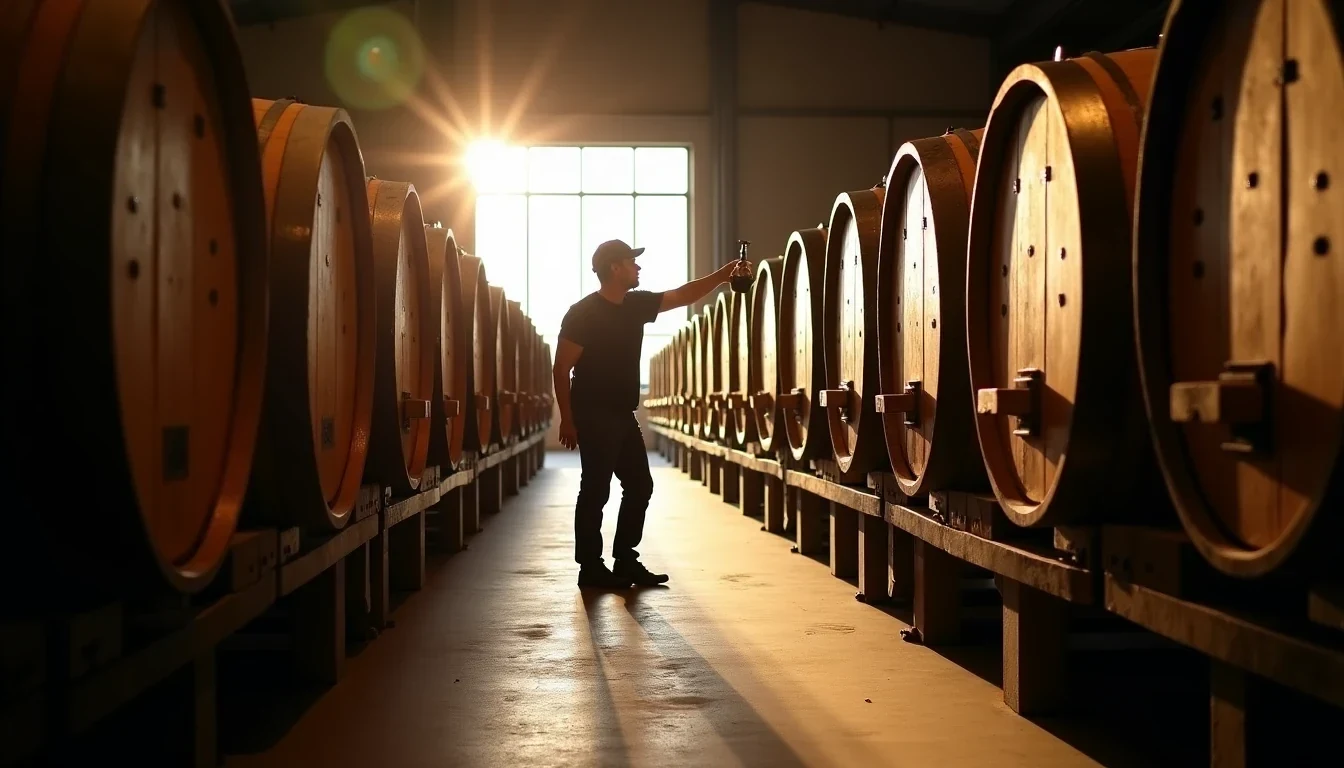
Casks expand and contract aggressively in this rhythm, pulling spirit deep into the oak and pushing it back out with an intensity Scottish warehouses never replicate. Maturation runs roughly 2.5 to 3 times faster than in Scotland. A 5-year-old Three Ships has wood interaction comparable to a 12 or 15-year-old Speyside. The trade-off is brutal: evaporation, the angel’s share, bleeds off 4 to 5 percent annually against Scotland’s 1 to 2 percent. Distillers here lose their stock faster and must manage casks with precision to avoid over-oaking. This whisky achieves complexity sooner but demands more intervention to get there.
The distillery and the brand are not the same thing
James Sedgwick founded his distillery in 1886, and for most of its life it made brandy. Whisky was an experiment that gathered momentum under Mike Dowie in the late 1970s and early 1980s, then became a mission when Andy Watts took over as Master Distiller in 1991. Watts made it the country’s only dedicated whisky distillery, built the technical infrastructure for consistent production, and spent three decades arguing that South African whisky deserved independent recognition rather than comparison to Scottish benchmarks. His 2020 induction into the Whisky Magazine Hall of Fame was personal validation, and it also certified the distillery’s institutional credibility.
Three Ships launched in 1990, four years before Watts arrived. The brand is a product of the distillery’s capabilities, not a summary of them. The distillery’s history includes decades of brandy production, equipment adaptations, and climate-specific problem-solving that no single bottle captures. When you buy a Three Ships expression, you are buying one output of that system. South African whisky is young enough that conflating brand and distillery flattens the actual story into marketing copy.
What is actually on shelves now
The core range you will find consistently in South Africa comprises two blends: Three Ships Select, the entry point, and Three Ships 5 Year Old Premium Select. The 5 Year Old has collected Gold medals at the International Wine and Spirit Competition, including Gold Outstanding in 2021, and remains the most reliable expression for buyers who want the distillery’s signature intensity without hunting limited stock.
The Three Ships 10 Year Old Single Malt appears periodically and sells out quickly. It was the first 100 percent South African single malt, and its 2012 World Whiskies Awards victory remains the brand’s most cited credential despite the category confusion. Older age statements, 12 and 15 year releases, surface as limited editions with irregular availability.
For current stock, major retail channels include Pick n Pay Liquor, Checkers LiquorShop, Makro, and Ultra Liquors. Specialist retailers such as Norman Goodfellows and WhiskyBrother&Co carry broader selections and are more likely to receive allocation of limited releases. Online platforms attached to these retailers offer the most practical route for tracking specific expressions outside major centres.
Has South African whisky earned its own grammar
The central claim for Three Ships, and for South African whisky generally, is that it has stopped imitating Scotch and started exploiting conditions Scotland cannot replicate. The flavour profile leans toward tropical fruit, vanilla, caramel, and robust spice rather than peat, maritime salt, or heather. Master Distiller Meryll Coetzee, who succeeded Watts in 2025, inherits a production philosophy that treats the Wellington climate as a creative tool rather than a deviation to be corrected.
Whether this constitutes a fully independent identity depends on your perspective. The barley is local. The water is local. The oak management is calibrated to local temperature swings. Yet the legal framework, the still shapes, and much of the production vocabulary remain recognisably descended from Scottish practice. The question is not whether South African whisky has severed all connection to its origins, but whether the connection has become a starting point rather than a destination.
Three Ships makes a strong case for the latter. The 5 Year Old Premium Select at its price point delivers concentration Scottish blends at equivalent age cannot match because the wood has worked harder. The 10 Year Old Single Malt, when available, demonstrates that extended maturation in this climate produces something other than accelerated Scotch. What it produces is still being defined, bottle by bottle, in a distillery that has only been serious about whisky for four decades. That is young by global standards, but old enough that the next generation of distillers is working with inherited technique rather than a borrowed template.






Join the conversation